
How can artificial intelligence help reveal what is happening in the oceans, even when satellite images are obscured by clouds?
This question is explored by Prof. Dr. Matej Kristan and Assistant Grega Rovšček, together with their co-authors, in the article DIRECT 1.0: a diffusion-based generative model for dense sea surface temperature reconstructions from sparse satellite observations. The article was published on the website of the European Geosciences Union (EGU).
The researchers developed the DIRECT method, which enables the reconstruction of missing sea surface temperature data and provides a more reliable view of ocean temperature patterns.
Because clouds often obscure large portions of the sea surface in infrared satellite imagery, obtaining accurate data is challenging. The proposed method fills in the missing information and generates multiple possible reconstructions.
The researchers tested the method using data from the Mediterranean Sea, the Adriatic Sea, and the North Atlantic Ocean, where it achieved better results than the existing approaches included in the comparison.
In the article, the authors emphasize that such more accurate sea surface temperature maps could contribute to improved weather and climate forecasts, as well as better monitoring of marine environments and oceanographic processes.
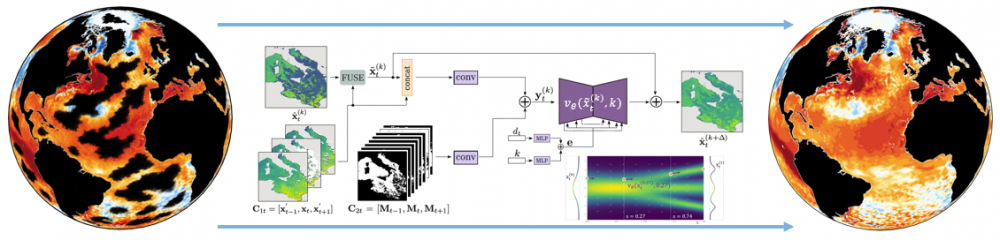
Image: Illustration of the DIRECT method for reconstructing sea surface temperature from incomplete satellite observations.